
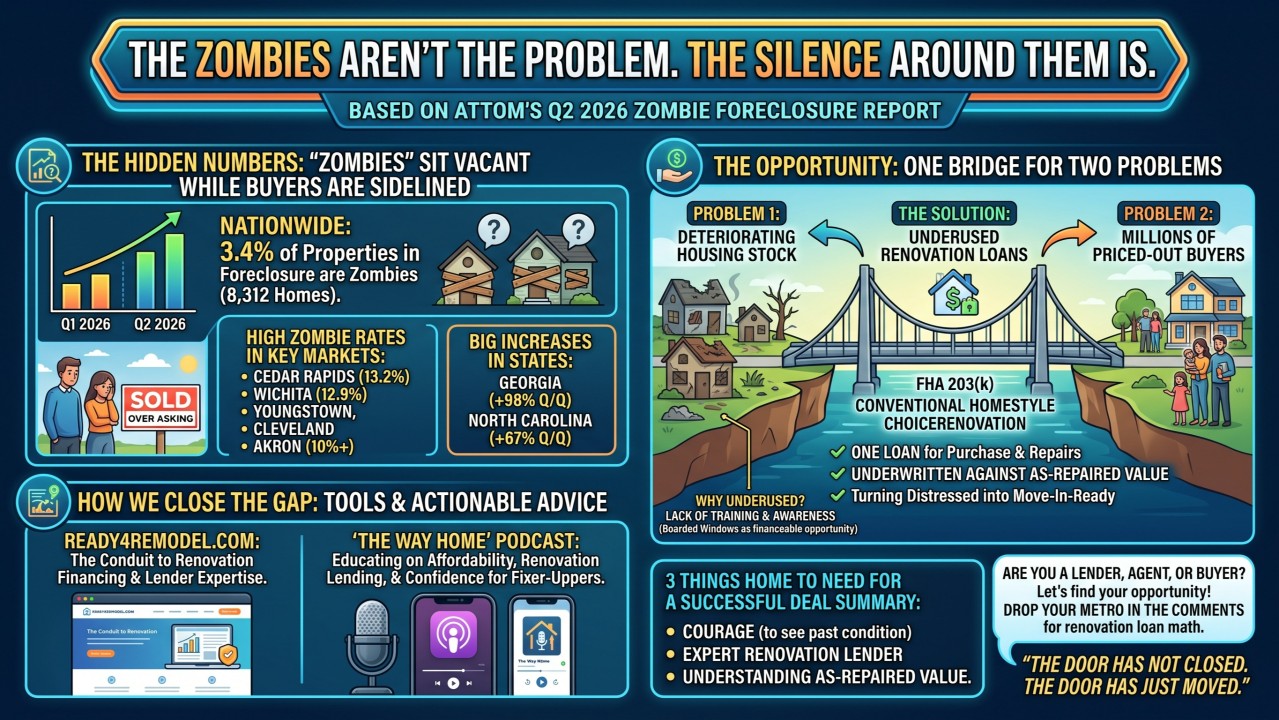
There's a number buried in ATTOM's newest Vacant Property and Zombie Foreclosure Report that most of the industry will scroll past: 8,312. That's how many "zombie" properties, homes abandoned by their owners before foreclosure even finished existed nationwide in Q2 2026. Out of 245,376 properties in the foreclosure process, 3.4% had already been left for dead.
It's a small percentage. ATTOM's own team calls the broader trend "encouraging," and they're right to. Nationwide vacancy sits at a steady 1.3%. This is not 2011. We are not staring down a wave.
But small percentages sitting on top of a housing shortage this severe are not small in absolute terms. And some markets are not seeing "small" at all, Cedar Rapids, Iowa is running a 13.2% zombie rate among its foreclosures. Wichita is at 12.9%. Youngstown, Cleveland, and Akron, Ohio are all north of 10%. Georgia's zombie count jumped 98% quarter over quarter. North Carolina jumped 67%. These are not abstractions. They are specific streets, in specific cities, with specific vacant houses on them sitting empty while a generation of would-be buyers sits sidelined.
That juxtaposition is the opportunity.
Two problems that solve each other
Problem one: there is real, physical, deteriorating housing stock sitting vacant in dozens of metro areas, dragging down neighborhood values and inviting further blight the longer it sits.
Problem two: millions of first-time buyers, many of them renters since before the pandemic have been priced and outbid out of a market that keeps handing new construction and move-in-ready inventory to buyers with more capital and fewer constraints.
Most of the industry treats these as two separate stories. They are the same story. A zombie property isn't a home that failed. It's a home that's waiting for the right loan product and the right buyer to walk through the door together. The renovation loan, FHA 203(k), and its conventional cousins HomeStyle and CHOICERenovation, is the only financial instrument built specifically to bridge that gap: one loan that buys the distressed house and funds the work to make it livable, underwritten against what the home will be worth once it's fixed, not what it's worth abandoned.
This isn't a new idea. It's an underused one. And it's underused because almost nobody in the transaction, not the listing agent, not the buyer's agent, not the buyer themselves, has been trained to see a boarded-up window as a financeable opportunity instead of a dead end.
The bridge has to be built on both sides
You can't solve this with financing alone. A first-time buyer standing in front of a zombie property needs three things at once: the courage to see past the condition of the house, a lender who actually knows how to close a renovation loan without it becoming a six-month ordeal, and a real understanding of what "as-repaired value" means for their budget. Miss any one of those and the deal, and the house stays dead.
That's the gap I built Ready4Remodel.com to close. It's the conduit between the distressed side of this market and the buyer side: matching properties like these zombie foreclosures with the renovation financing and lender expertise that can actually convert them, and giving first-time buyers the plain-language education they need to walk into a fixer-upper with confidence instead of fear.
And because the biggest obstacle to all of this isn't the properties or the products it's awareness. I also just launched a podcast built to close that gap directly: The Way Home. It walks through exactly this terrain; the state of housing affordability, how renovation lending actually works, and why the home you can afford to fix is often a better path to ownership than the one you can't afford to buy finished.
Where this goes from here
Zombie foreclosures will likely keep hovering in this low-single-digit range nationally, that's the healthy story ATTOM is telling. But "low nationally" is cold comfort if you're a buyer in Cedar Rapids or Wichita or Youngstown watching vacant, financeable houses sit untouched in your own market because no one showed you or your agent the path to fix one.
That path exists. It has existed since 1978. It just hasn't had enough people pointing to it.
If you're a lender, an agent, or a buyer looking at distressed inventory in your market and wondering whether it's worth the conversation... it is. Drop your metro in the comments and I'll tell you what the renovation loan math could look like there.
The door has not closed. The door has just moved.