
So what happens when the 800-pound gorilla walks out of the renovation loan industry?
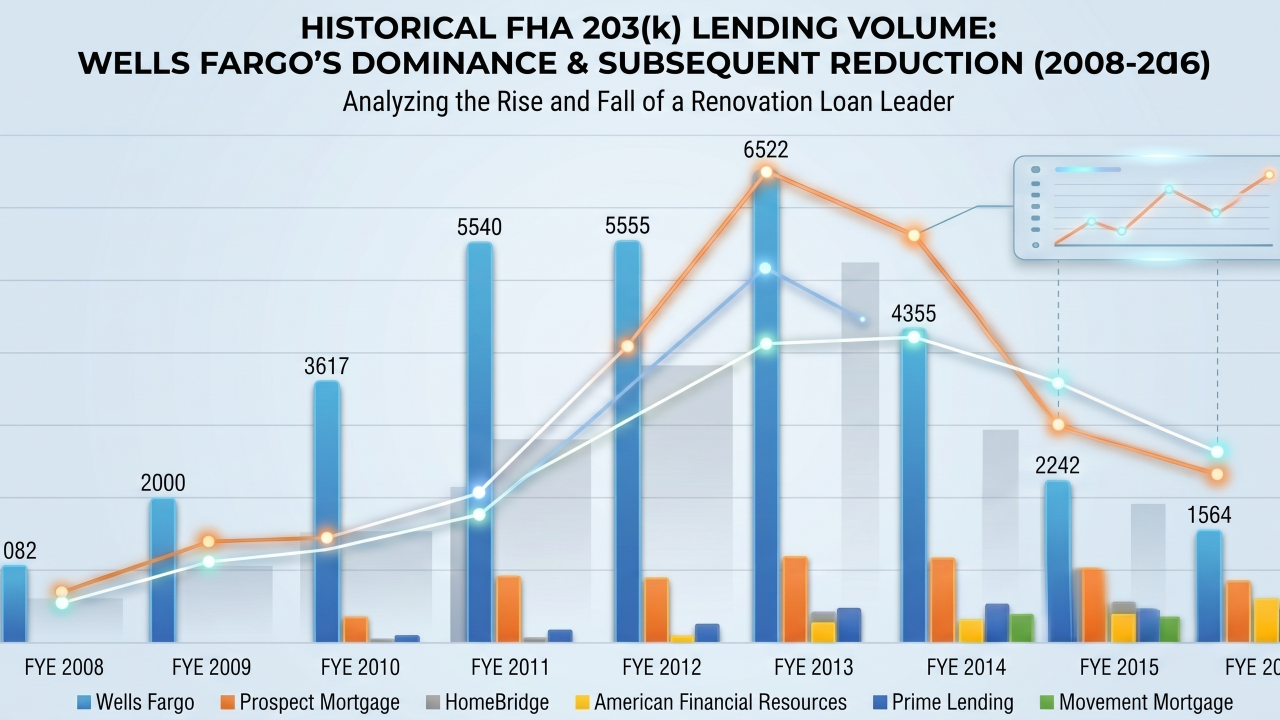
For years, Wells Fargo was the renovation loan industry. From 2000 through 2016, it dominated renovation lending originating well over a billion dollars a year in renovation loans between 2010 and 2014 and, at the 2013 peak, closing roughly 29% of every 203(k) loan in the country. One lender. Nearly a third of the entire market. That same year, the industry as a whole closed about 22,500 of these loans.
Then the gorilla started backing out of the room. Wells Fargo wound down its FHA and renovation originations and by January 2014, had formally retreated from the renovation-lending business it once led nationally.
Here's the part nobody plans for. When the 800-pound gorilla leaves, you don't just lose the gorilla. You lose everyone who was hanging onto its coattails. The thousands of loan officers who learned the product because the big player made them. The bank branches that doubled as marketing engines, putting "renovation loan" in front of borrowers in towns where no one else was talking about it. The referral habits of real estate agents who knew exactly where to send a buyer with a fixer upper.
All of it went quiet.
The numbers tell the story without much help. FHA 203(k) volume fell from ~22,500 peak in 2013 to just 3,683 loans in fiscal year 2025. The roster of active 203(k) lenders thinned out dramatically over the same stretch. Two-thirds of the players are simply gone. The infrastructure that made renovation lending a mainstream option didn't get replaced, it evaporated.
So, did the demand dry up? Not even close.
This is where the story gets interesting, because the need didn't shrink. It exploded.
The American housing stock is older than it has ever been. The median age of an owner-occupied home in this country hit 42 years in 2024, up from 31 years in 2005 and roughly 47% of those homes were built before 1980 (NAHB analysis of Census ACS data). More than 50 million owner-occupied homes are now decades old, carrying the deferred maintenance that comes with age.
Think about what that actually means at the kitchen table level. When these homes were built, the major systems: HVAC, roofing, windows, doors, electrical, plumbing were engineered to last 20, 30, maybe 40 or 50 years. Every one of those systems is a clock ticking down to zero. Across tens of millions of homes, those clocks are running out right now. The roof that's leaking. The furnace on its last winter. The electrical panel that can't handle a modern household. This isn't speculative demand. It's physics and time.
So the demand for renovation financing didn't disappear when Wells Fargo left. It grew — while the capacity to serve it collapsed. That's not a dead market. That's a gap.
Who filled the gap? Mostly the wrong tool.
Into that void stepped the fix-and-flip lenders. In 2025, investors flipped 297,045 single-family homes and condos, the lowest count since 2020 and notably, the median flipped home that year was built in 1978, the oldest on record (ATTOM). Investors are literally chasing the same aging inventory.
But the flip model is straining. Gross profit per flip fell to $65,981 in 2025, down from $77,000 the year before, and returns dropped to 25.5%, the worst since 2008 (ATTOM). High acquisition costs and tight inventory are squeezing the math.
Those numbers don’t sound bad, until you understand the math. Gross profit is the difference between what the Investor paid for the property and what they sold it for after the flip… After remodeling costs, holding costs, paying the hard money lender 2-3 points and after real estate commissions. There’s not much left and that’s why the fix and flip business is down.
Here's the thing: the flipper buys the house, fixes it, and sells it to someone else, often at a marked-up price. The renovation loan does something fundamentally different. It lets the family buy that tired house and fix it themselves, building equity instead of handing it to an investor. One model extracts value from aging homes. The other puts it back in the hands of homeowners and first-time buyers.
The question that matters
So here's the real question for 2026:
Is there a mortgage company with the ability and the desire to fill the void Wells Fargo left behind? A company that can step in and close 6,500 renovation loans a year, for starters, the kind of volume the dominant player once did single-handedly? A company that sees an aging nation of 50-million-plus homes not as a problem, but as the single largest untapped opportunity in residential lending?
A company willing to actually invest in America's housing and in the first-time homebuyers who can't afford move-in-ready but can afford to build it?
The gorilla left. The houses got older. The buyers are still out there, 5 to 7 million of them who got pushed out since the pandemic, standing in front of homes with good bones and dying systems, looking for someone to say yes, we can help you finance that and we want to.
Whoever decides to answer doesn't just win a product line. They inherit a market that the rest of the industry walked away from at exactly the moment it needed them most.
Sources: HUD CHUMS FHA 203(k) endorsement data; U.S. Census American Community Survey / NAHB housing-age analysis; ATTOM 2025 Year-End U.S. Home Flipping Report.