
I've been asked some version of this question for 32 years.
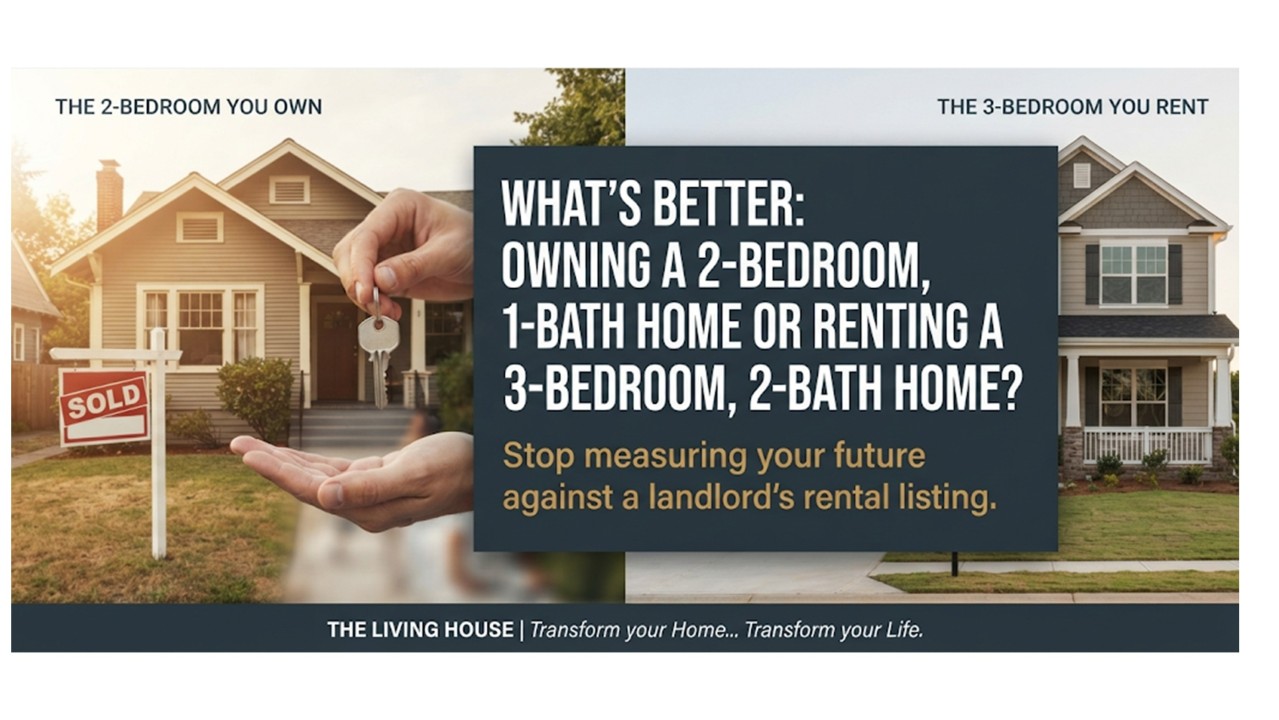
A young couple sits across from me. One kid, maybe another on the way. They've toured a tidy 3-bedroom, 2-bath rental with a two-car garage, and they've toured a 2-bedroom, 1-bath bungalow they could actually buy. The rental is bigger. The rental is newer. The rental feels like the life they pictured.
And almost every time, my answer is the same: buy the smaller house.
Not because square footage doesn't matter. Because whose square footage it is matters more.
The expectation problem
Somewhere along the way, first-time buyers absorbed the idea that their first home should look like their parents' current home. It shouldn't. Your parents most likely didn't start there either.
The numbers show what that expectation is costing us. According to NAR's 2025 Profile of Home Buyers and Sellers, first-time buyers fell to a record-low 21% of the market, and the median first-time buyer is now 40 years old, up from the late 20s in the 1980s.
Forty. That's a decade or more of rent checks, of kids growing up in someone else's house, of waiting for the "right" home while the wrong one quietly builds equity for a landlord.
Some of that delay is affordability, plain and simple. I'm not going to pretend otherwise. But some of it is buyers holding out for a home that matches the rental they can't stop comparing it to. That's the part we can change.
What ownership does to your head
I've watched hundreds of families take the keys to their first home. Here's what I've seen happen, not in a study, but in kitchens and driveways across California and beyond.
People stand differently. There is a confidence that comes from knowing nobody can decide not to renew your lease. That you won't get a 60-day notice because the owner wants to sell. That the wall you want to paint, you can paint.
People start thinking in decades instead of months. Renters plan to the end of the lease. Owners plant trees. That shift from "how do I get through this year" to "what do I want this place to be in ten years" changes how people handle money, careers, and each other.
People invest in their community. They meet the neighbors because they're going to be neighbors. They show up to the school board meeting because it's their school district now.
I call this the soul of the home in my recently released Amazon #1 bestselling book. In the framework for The Living House, a home has boundaries, flows, intelligence and a soul. A rental can give you the first three. The soul is what you build when the place is yours.
What it does for your kids
This is where I want to be careful, because it's where our industry tends to overclaim.
There is real research here. A widely cited study by Haurin, Parcel, and Haurin (Real Estate Economics, 2002) found that children of homeowners had higher-quality home environments, math scores up to 9% higher, reading scores up to 7% higher, and fewer behavior problems than children of renters, after controlling for a long list of economic and family factors.
But in fairness, a later study by Holupka and Newman (2012) used different methods to account for the fact that families who buy may differ from families who rent in ways that are hard to measure and found little evidence of a direct homeownership effect. The academic debate is genuinely unsettled.
So here's what I'll stand behind: stability. Census data has consistently shown that roughly 38–42% of renters are recent movers, compared with 9–12% of owners. Redfin found the typical renter stayed in their home about two years in 2021, versus 13 years for homeowners.
Two years versus thirteen. For a child, that's the difference between one school and four. One set of friends and four. One bedroom door with their height marked on the frame or none.
A 2-bedroom house where the kids share a room for a few years, in a neighborhood they'll grow up in, beats a 3-bedroom house they may be packing up out of before third grade.
The financial case
Let's get specific. These are illustrative numbers, not a quote; your rate, taxes, and insurance will differ.
A $300,000 home with an FHA loan:
Now here's the part renters never see: in year one alone, roughly $2,850 of those payments go to principal, money you're paying to yourself. And that number grows every single year as the loan amortizes.
Equity over 10 years on that same home:
The renter paying a similar amount for a bigger place? At the end of ten years, their equity is zero and their rent has almost certainly gone up, while the owner's principal and interest payment hasn't moved a dollar. Ten years paying $1,500/month in rent is $180,000 out the window.
That's what shows up in the Federal Reserve's Survey of Consumer Finances: in 2022, the median homeowner had a net worth of $396,200. The median renter: $10,400.
Is all of that gap caused by the house? No, about half of the typical homeowner's net worth is home equity, and owners tend to have higher incomes to begin with. But the house is the single biggest wealth-building tool most American families will ever have. That's not a slogan. That's the data.
The tax picture
I'm going to tell you something many articles won't: for a lot of first-time buyers, the mortgage interest deduction won't move the needle in year one.
The 2026 standard deduction is $32,200 for married couples filing jointly. On the example above, first-year mortgage interest is about $21,000 and property tax about $3,300. That's under the standard deduction — so most couples in that price range will simply take the standard deduction.
Where taxes do work in your favor:
Talk to a tax professional. But don't buy a house for the deduction. Buy it for the equity and the exclusion.
"But it's only two bedrooms."
Here's where my world comes in.
That 2-bed, 1-bath house isn't a life sentence. It's a starting point, and often a bargain because it's smaller or dated.
With an FHA 203(k) renovation loan, a buyer can finance the purchase and the improvements in a single mortgage, based on the home's after-improved value. Adding $30K - $50K to update the Kitchen, Bathrooms replace the flooring or windows makes a world of difference when moving into a dated home. With a Standard 203(k), that can include structural work like adding a bedroom or a second bath, the very things that made the rental look better in the first place.
So the real comparison isn't "2/1 you own vs. 3/2 you rent." It's "2/1 you own that can become a 3/2 vs. a 3/2 that will never be yours."
Resetting the expectation
To first-time buyers: your first home doesn't have to be your forever home. It has to be your home. Smaller, older, a little rough around the edges, those are features, not flaws, if they're what get you in the door.
To my fellow agents and loan officers: we have to stop letting buyers measure their first purchase against a rental listing. When we hear "it's too small," that's our cue to show them what the house can become and what ten more years of renting will cost them.
Ownership isn't just a financial decision. It's a decision about who you become while you live there.
Transform your Home… Transform your Life.
So I'll put it to you: If you had to choose today... The 2-bedroom you own or the 3-bedroom you rent; which would you pick, and why? And for the professionals here: what's the one conversation that finally got a hesitant buyer to say yes to a smaller home? Tell me in the comments.